You describe what you want to achieve.
A sentence is enough. Lazing does not ask you to choose the right app first.
Describe the outcome. Lazing builds the working surface around it.
git clone https://github.com/MaximilianGerhardt/lazing.git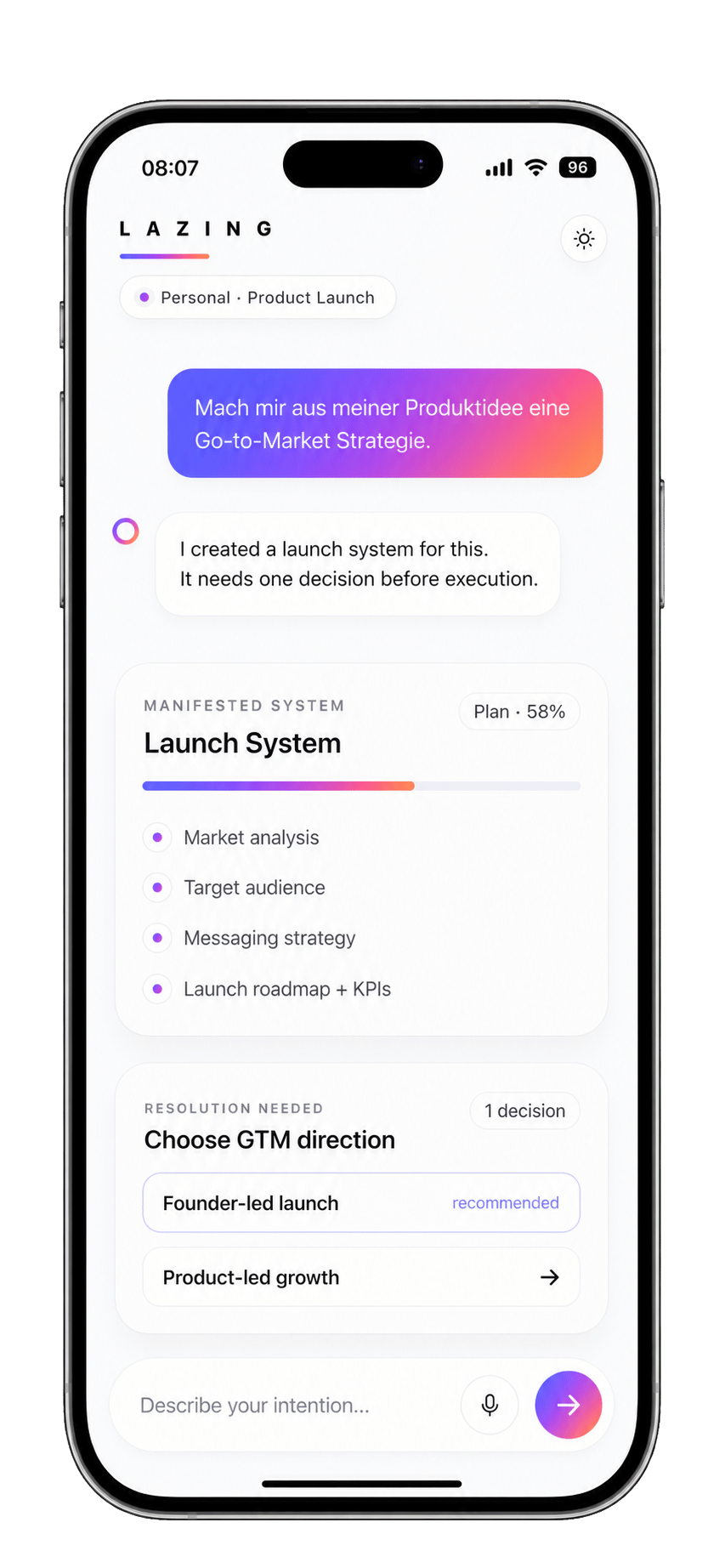
 Codex
Codex Claude Code
 Ollama
From Intent To Impact
Lazing begins before the menu, before the dashboard and before the right structure is obvious. You describe the outcome. The system forms around the work.
A sentence is enough. Lazing does not ask you to choose the right app first.
Personal, organization, client, documents, credentials and boundaries shape what should happen next.
The system can use the logic an expert would normally carry in their head.
The system follows the method, checks the missing inputs and keeps work from becoming vague.
Codex, Claude Code, Ollama or local agents can help without owning the whole context.
A plan, tracker, decision card, workflow, document or workspace appears when the work needs it.
Approve, adjust, delegate or pause before sensitive work continues.
Every result can leave a scoped record of context, decision and execution.
Plain Difference
The engines can reason, code and compare. Lazing decides which field they may touch, which surface should appear and what must be confirmed before work continues.
Chat is one input. The output can be a plan, tracker, decision, workspace or trace.
Codex, Claude Code and Ollama do useful work. Lazing keeps scope, surface and memory honest.
Creator expertise becomes a pack people use, not a post people save and forget.
Manifestation Layer
A chat answer should not always remain text. Sometimes it should become a plan, a decision, a tracker, a review panel, a workspace or a routine that keeps working.
An idea opens into workstreams, assets, timeline, KPIs and the decisions still missing.
Approve, adjust, delegate or pause without reading another wall of text.
A meal, deadline or routine becomes a living state instead of a forgotten note.
Legal, code or strategy work can surface risks, alternatives and consensus.
A project gathers context, credentials, documents, trace and next actions.
Fields And Boundaries
Personal work, organizations, clients and projects stay separated. Credentials, documents, RAG spaces and agent capabilities belong to the field that owns them.
Private notes, fitness, family, learning, documents and routines stay personal.
Teams, customers, invoices, legal documents and shared workspaces stay scoped.
Access belongs to the field that owns it. Sensitive use asks first.
The runtime keeps decisions, changes and agent work understandable.
Pocket Command Center
Send an idea, approve a plan, answer a quick choice, continue an agent, switch a workspace or retrieve a result from your pocket.
Fix the chat bug and compare Claude Code against Codex.
Agent running. Tests pending. One decision needed.
Skills + SOPs
Skills hold reusable expertise. Processes hold repeatable quality. Manifestations turn both into interactive work: not just something to read, but something to run.
Start Locally
Lazing is designed for your local machine or VPS. Connect engines when you are ready, keep credentials scoped and let trace stay close to the host.
For Developers
Codex, Claude Code, Ollama and local agents are engines. Lazing keeps them scoped, gives them the right surface and records what happened.
For Creators
A creator can turn repeatable expertise into skills, processes, routines and working interfaces that help people get better outcomes.
Trust, Privacy, Europe
Local-first operation, no unscoped memory, isolated fields, scoped credentials, consent before sensitive use and traceable events. Designed with European privacy expectations in mind.
FAQ
Lazing is an adaptive command center. You describe what you want to achieve, and Lazing forms the right working system around it: a plan, decision, tracker, workflow, workspace, document, or traceable resolution.
Yes. Lazing is planned as an open source runtime and public standard direction, with the website serving as the public home for users, builders, creators, and community.
No. Codex, Claude Code, Ollama and local agents are optional engines. Lazing is the cockpit, scope and trace layer around them.
Yes. Ollama is part of the local-first adapter direction, so builders can run local models while keeping scope and trace inside their own runtime.
Lazing is designed for local or VPS operation. The host runtime keeps authority over credentials, scoped memory, adapter capabilities, and trace data.
The Manifestation Layer is the concept behind turning intent into useful work surfaces. In plain words: an answer can become a plan, decision card, tracker, review panel, workspace or routine instead of remaining only text.
Manifestation Packs combine reusable expertise, required data, risks, confirmations, and quality logic so an intention can become an executable working system.
No. Chat can be the starting point, but Lazing focuses on forming scoped systems and adaptive interfaces around the work.
Yes. Lazing is designed so creators can turn repeatable expertise into skills, SOPs, routines, lenses, templates, and expert tracks that others can run.
One Interface. Infinite Possibilities.